In 2024, the Guangdong Department of Science and Technology, Beijing Normal–Hong Kong Baptist University (BNBU) and Hong Kong Baptist University (HKBU) jointly launched the Guangdong and Hong Kong Universities “1+1+1” Joint Research Collaboration Scheme.
With a three-year funding commitment of approximately RMB 90 million, the scheme has supported 36 collaborative research projects across its first two rounds, with the third round of approved projects to be announced soon.
The scheme brings together researchers from the two universities to tackle complex questions. Three projects from the first round illustrate how this model is advancing research.
Making sign language communication safer and more accessible
For Prof Chen Donglong of the Department of Statistics and Data Science at BNBU’s Faculty of Science and Technology, improving communication between hearing-impaired and hearing people has a personal dimension. As a child, he had a hearing-impaired neighbour, but their different means of communication often made interaction difficult. The experience inspires him to explore how technology might help bridge the gap.
When Prof Li Yupeng of HKBU’s Department of Interactive Media invited him to collaborate, Prof Chen readily agreed. Together, they lead a research team comprising postgraduate and undergraduate students from both universities on a project focusing on real-time and secure sign language recognition and generation.
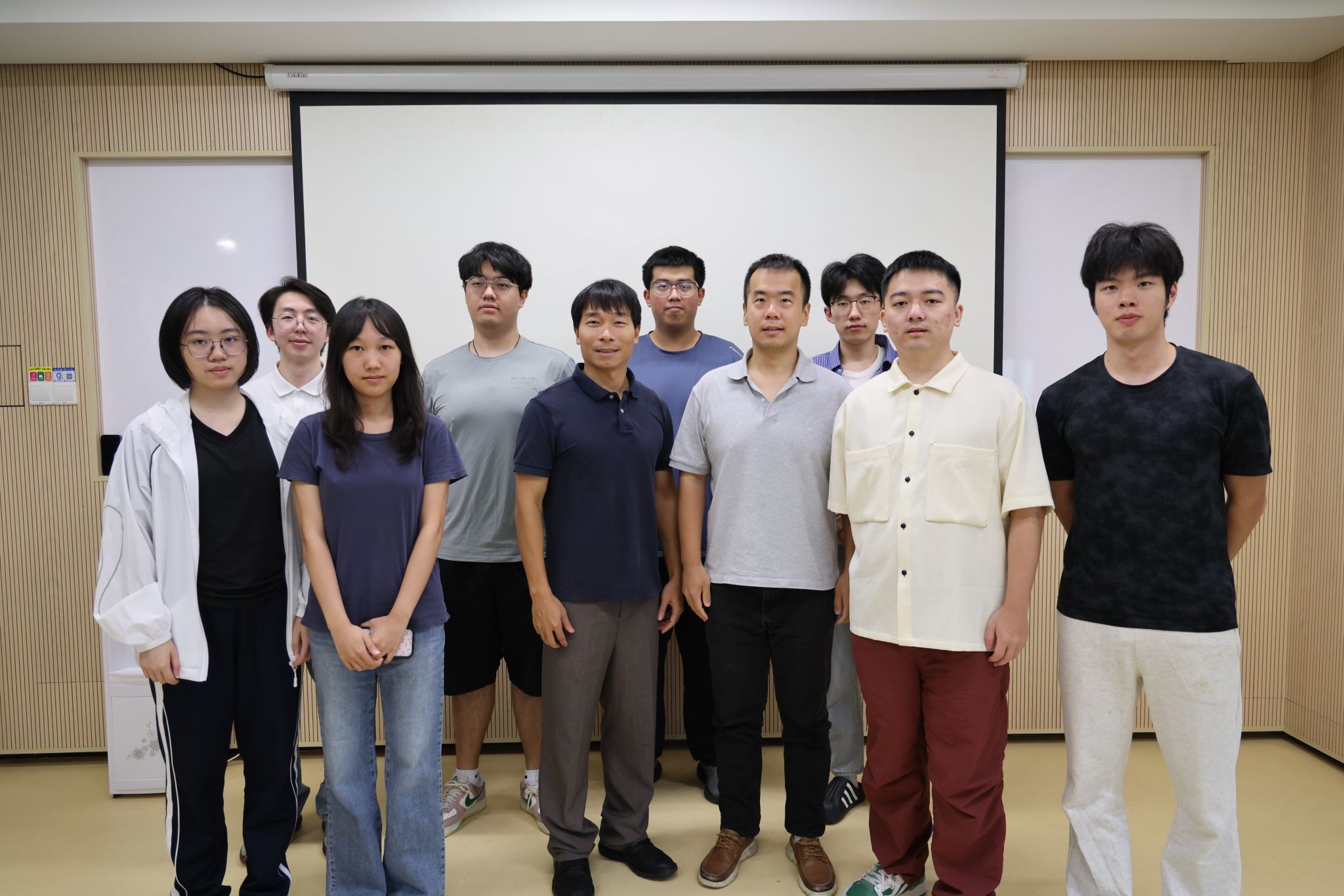
Prof Chen Donglong (thrid from left, front row) and Prof Li Yupeng (fourth from left, front row) with student team
By integrating computer vision and natural language processing, the project aims to develop an intelligent system for real-time, accurate, two-way sign language recognition and natural language generation. The team is also developing an assistive sign language learning system, with the goal of supporting more reliable, secure and timely communication in everyday situations, including social interactions and medical consultations.
The challenges extend beyond technical issues. Sign language includes not only hand gestures but also facial expressions and body movements, and signs can differ across regions. For example, Prof Chen explains, the Chinese mainland uses one sign for “refrigerator”, while Hong Kong uses another.
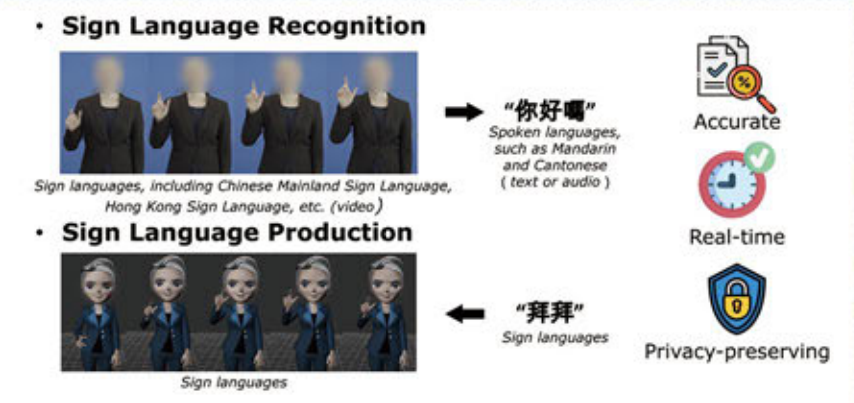
Privacy is another critical consideration because sign language recognition may involve sensitive facial information. The team is exploring privacy-preserving computing techniques that would allow sign language data to be uploaded to a server for recognition and generation without exposing the original information to the server, an approach described as “usable but invisible”.
The partnership allows the researchers to combine complementary expertise. Prof Chen focuses on privacy-preserving computing and computer vision, while Prof Li contributes expertise in large language model technologies, trusted networks and social computing. Collaboration between the two universities also supports data collection across different regions and the exploration of diverse perspectives.
Bringing ancient bronze bells into the digital world
A second project demonstrates how interdisciplinary research can open new possibilities for studying and experiencing cultural heritage.
Prof Eugene Ch’ng FSA, Dean of BNBU’s School of Culture and Creativity, and Prof Li Kin Sum of HKBU’s Department of History are leading digital studies of pre-Qin bronze bells. The project combines archaeological and historical research with acoustics, three-dimensional modelling, artificial intelligence (AI) and interactive media to investigate ancient Chinese bronze bells, and brings together acoustic simulation, data analysis and AI to investigate the relationships between a bell’s shape, casting techniques and pitch, with the findings informing immersive XR experiences.
The work enables the archaeologists and historians to interpret artefacts in their historical and cultural contexts with data from large-scale digital modelling, while Computing specialists can be more accurate in applications with in-depth historical and archaeological knowledge.
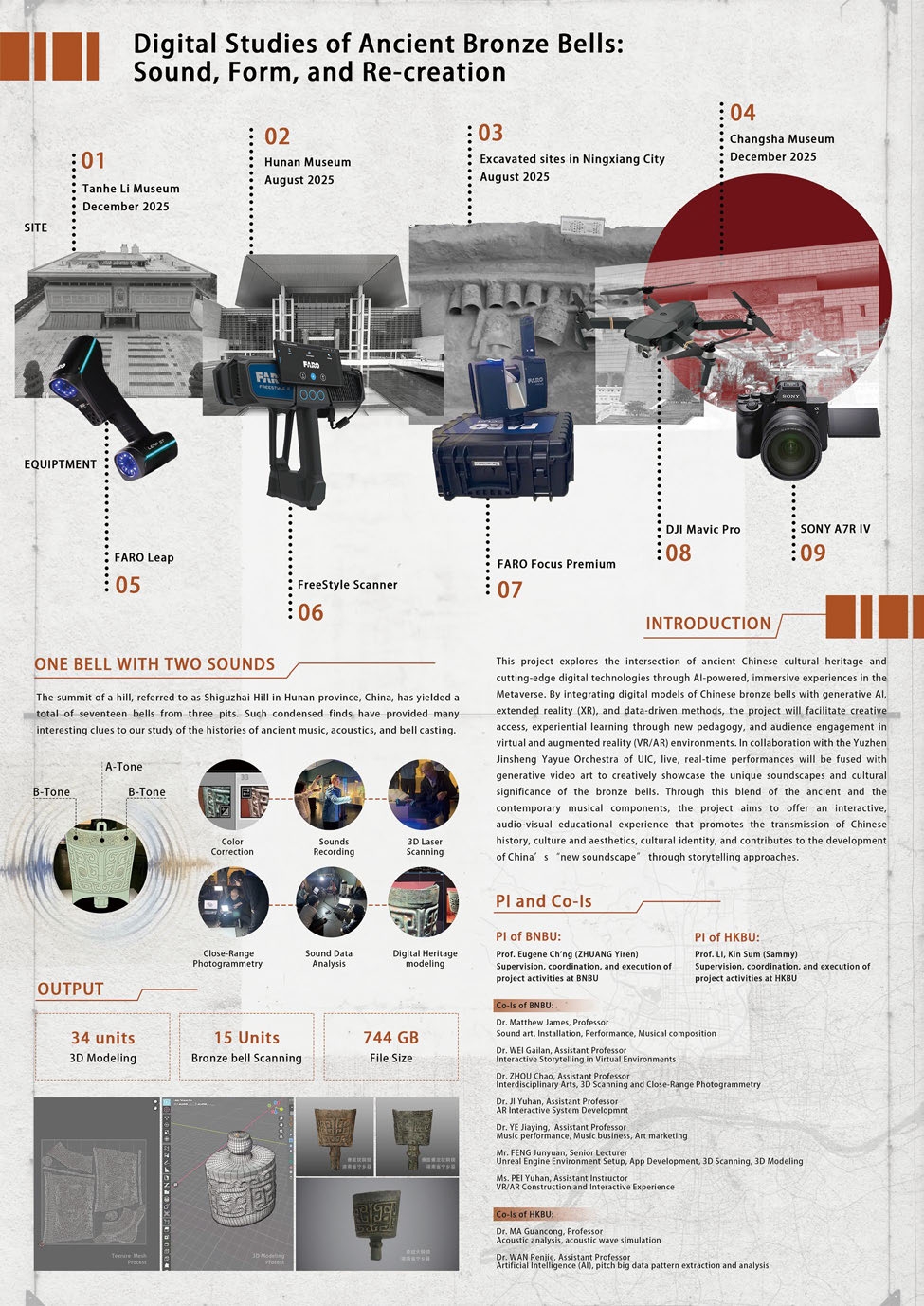
Reconstructing the sounds of ancient bells and understanding how they were made require these different forms of expertise to work together. Prof Ch’ng’s research focuses on digital cultural heritage, XR and AI, while Prof Li specialises in ancient Chinese art and archaeology and the application of 3D digital technologies to the study of artefacts. The wider team also includes researchers in physics and specialists in musical performance, each contributing distinct expertise to the project.
Practical constraints add another layer of complexity. Many ancient bells are held in museums, and some have never been sounded since their excavation. The team therefore travels to museums with heavy 3D scanning equipment to collect data on site. The resulting dataset has reached 744 gigabytes.
The work has already produced academic outputs across ancient Chinese art and archaeology, physical acoustics, AI and computer vision, digital cultural heritage, and VR/XR. 13 related papers have been published or accepted for publication, with selected findings appearing in Humanities and Social Sciences Communications and npj Heritage Science, both part of the Nature Portfolio. An immersive XR project developed by the research team with student participation, Echoes in Bronze, has also been accepted for presentation at SIGGRAPH Asia 2026.
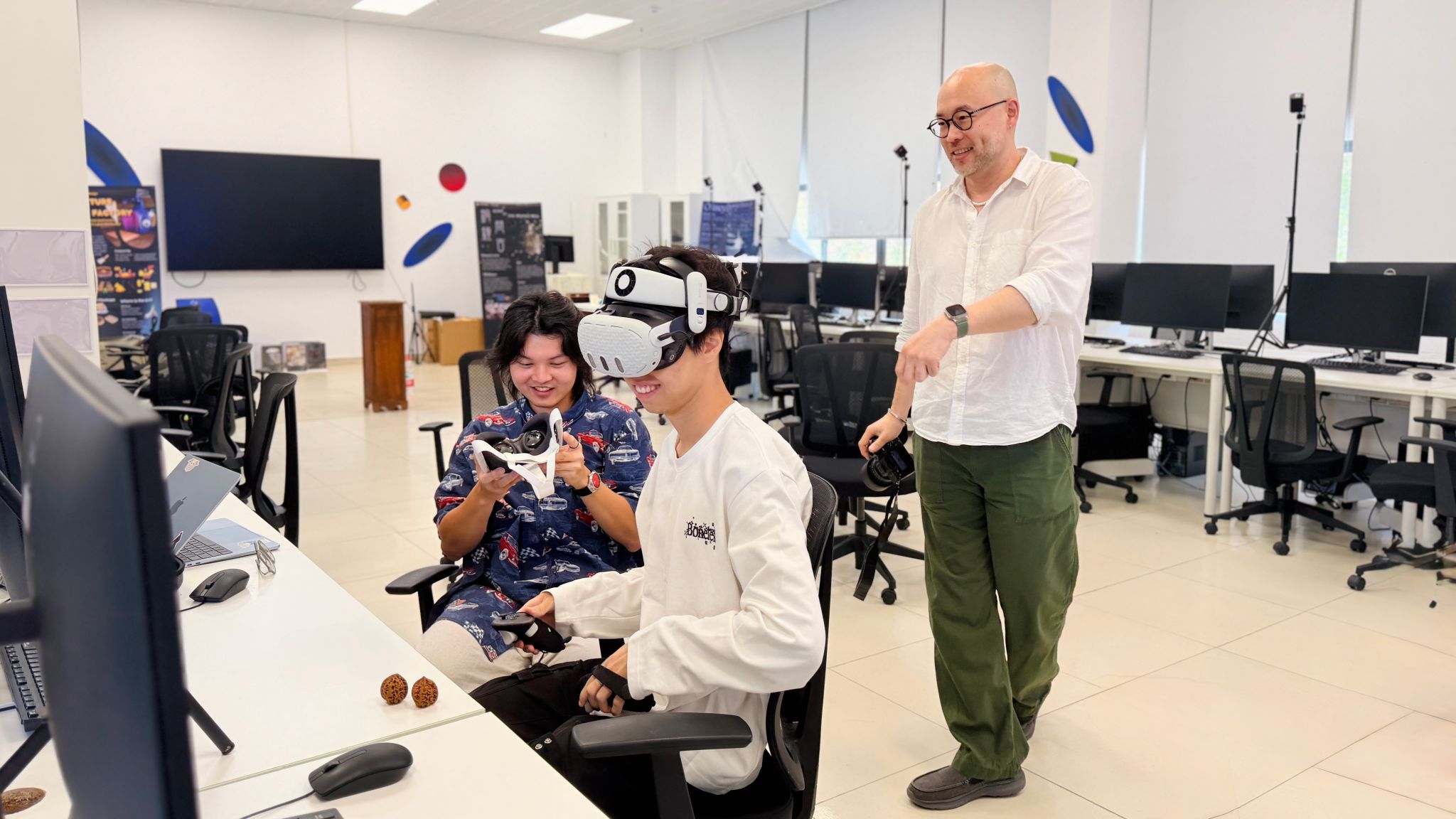
Prof Eugene Ch'ng with students practicing XR equipments
Using data science to understand the evolution of port systems
A third project applies interdisciplinary methods to a question: how have institutions and historical development shaped the evolution of port systems?
Prof Adolf Ng, Dean of BNBU’s Faculty of Business and Management and a researcher in modern logistics and supply chain management, is collaborating with Prof Tam Ka Chai of HKBU’s Department of History on a project that examines how institutional arrangements and historical development pathways have influenced port systems.
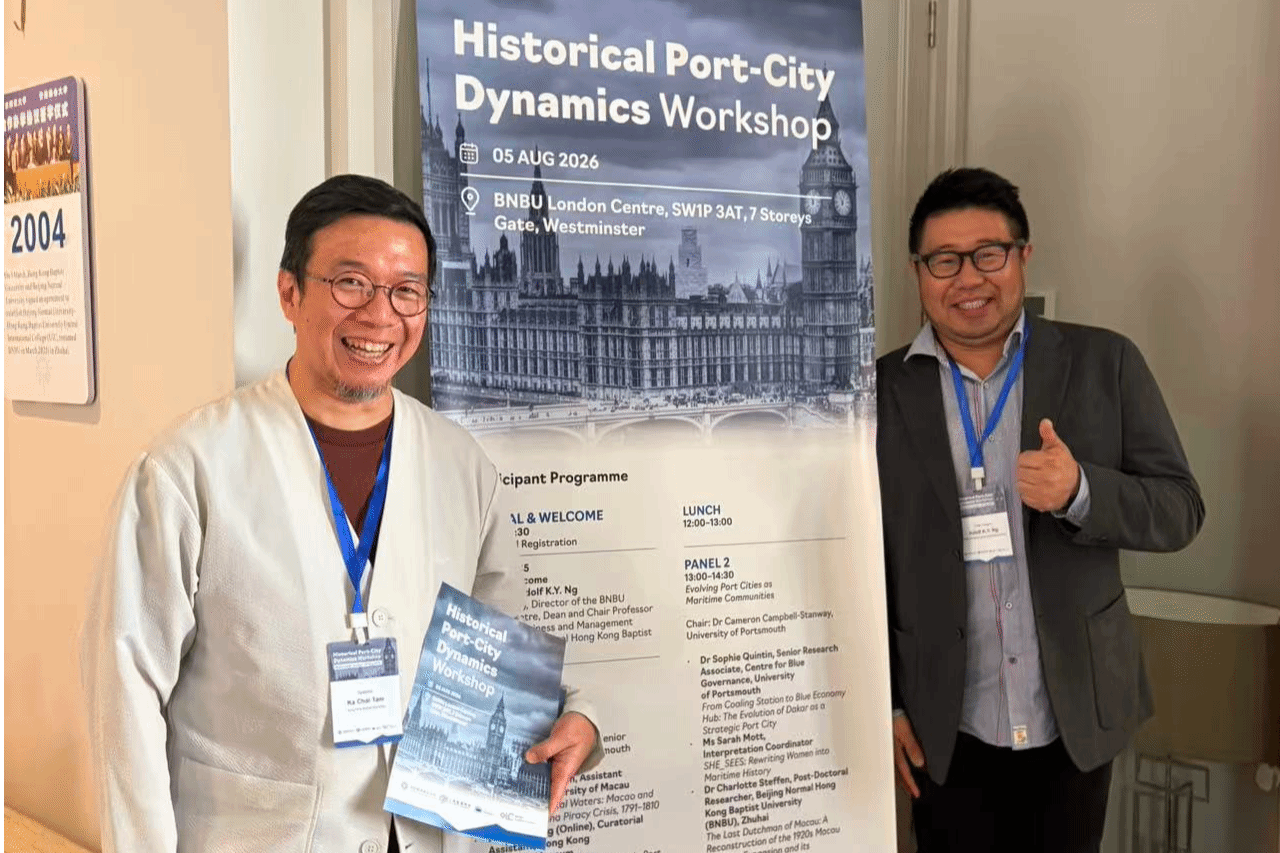
Prof Adolf Ng (right) and Prof Tam Ka Chai at BNBU London Center, hosting Historical Port-City Dynamics Workshop
As Prof Ng notes, ports are more than terminals, ships and containers. They are connected to the fortunes of cities, supply chains, global trade, regional economies and societies. Understanding their history, he argues, can offer insights into the future possibilities of the Greater Bay Area’s ports.
The team has collected and organised historical documents from the Republican era covering shipping, water conservancy and port management. Using optical character recognition (OCR) and digitisation techniques, researchers are converting extensive collections of incomplete physical records, many handwritten in traditional Chinese, into datasets that can be analysed quantitatively, comparing the historical development of ports in Guangzhou, Hong Kong and Shanghai.
The project draws on history, economics, data science and management. Historians establish the facts and context; economists help explain institutions and incentives; data scientists process and analyse the information; and management researchers consider the implications for policy and practice.
The study material of the project
Researchers often approach problems in different ways, and collaboration can sometimes become unbalanced. “Researchers from history, management and computer science think differently,” he says. “If collaboration is not properly organised but tilt to one field, it is not truly interdisciplinary. We need mutual trust, a reasonable division of responsibilities and recognition of each contributor’s work.”
This is where the “1+1+1” scheme offers particular value: it brings together researchers with complementary perspectives and capabilities across institutional and geographical boundaries, enabling them to address complex problems more systematically. The goal is to achieve results greater than the sum of individual contributions.
Bringing research into the classroom
For all three teams, the value of research also creates opportunities for students to engage with real-world problems and develop the skills needed to address them.
In Prof Chen’s sign language project, doctoral students and research assistants focus on technical development and core algorithms, while undergraduates contribute to application prototypes and demonstrations for sign language learning. Although undergraduates may have less specialised knowledge, “they have strong learning ability, openness and imagination.”
Prof Ch’ng also invites undergraduates studying animation and interactive media to participate in the work. He believes that in an era of rapid AI development, teachers need to engage with cutting-edge research to bring new knowledge into the classroom. He also encourages students to look beyond disciplinary boundaries, noting that “mathematics, art and the humanities remain fundamental to innovation”.
Prof Ng likewise sees research as essential to educational innovation. His current team consists mainly of doctoral students, and he plans to involve undergraduates with backgrounds in business analytics in future data analysis work. “Good teaching is possible without research, but transformative education requires teachers to conduct research,” he says.
Together, the three projects show how the “1+1+1” scheme is connecting disciplines, institutions and generations of researchers. By combining complementary expertise, addressing practical challenges and involving students in the research process, the partnerships are advancing knowledge while helping prepare students to tackle complex problems in an increasingly interconnected world.
From MPRO
Photos provided by the interviewees
Editor: Cecilia Yu


